In mathematics, a smooth maximum of an indexed family x 1, ...,x n of numbers is a smooth approximation to the maximum function  meaning a parametric family of functions
  such that for every α , the function
  is smooth, and the family converges to the maximum function
  as
as  . The concept of smooth minimum is similarly defined. In many cases, a single family approximates both: maximum as the parameter goes to positive infinity, minimum as the parameter goes to negative infinity; in symbols, as and
  as
as  . The term can also be used loosely for a specific smooth function that behaves similarly to a maximum, without necessarily being part of a parametrized family.
Examples [edit]

Smoothmax of (−x, x) versus x for various parameter values. Very smooth for  =0.5, and more sharp for =8.
For large positive values of the parameter  , the following formulation is a smooth, differentiable approximation of the maximum function. For negative values of the parameter that are large in absolute value, it approximates the minimum.
-
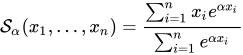
 has the following properties:
-
 as
as -
 is the arithmetic mean of its inputs
 -
 as
as
The gradient of is closely related to softmax and is given by
-
![{\displaystyle \nabla _{x_{i}}{\mathcal {S}}_{\alpha }(x_{1},\ldots ,x_{n})={\frac {e^{\alpha x_{i}}}{\sum _{j=1}^{n}e^{\alpha x_{j}}}}[1+\alpha (x_{i}-{\mathcal {S}}_{\alpha }(x_{1},\ldots ,x_{n}))].}](https://wikimedia.org/api/rest_v1/media/math/render/svg/1a1ed2997b3a0ceb8682440a0374158074ee3c73)
This makes the softmax function useful for optimization techniques that use gradient descent.
LogSumExp [edit]
Another smooth maximum is LogSumExp:
-

This can also be normalized if the  are all non-negative, yielding a function with domain
  and range
  :
:
-

The  term corrects for the fact that
  by canceling out all but one zero exponential, and
  if all are zero.
p-Norm [edit]
Another smooth maximum is the p-norm:
-

which converges to  as
as  .
.
An advantage of the p-norm is that it is a norm. As such it is "scale invariant" (homogeneous):  , and it satisfies the triangular inequality.
Other choices of smoothing function [edit]
-
 [1]
[1]
Where  is a parameter.
See also [edit]
- LogSumExp
- Softmax function
- Generalized mean
References [edit]
- ^ Biswas, Koushik; Kumar, Sandeep; Banerjee, Shilpak; Ashish Kumar Pandey (2021). "SMU: Smooth activation function for deep networks using smoothing maximum technique". arXiv:2111.04682.
https://www.johndcook.com/soft_maximum.pdf
M. Lange, D. Zühlke, O. Holz, and T. Villmann, "Applications of lp-norms and their smooth approximations for gradient based learning vector quantization," in Proc. ESANN, Apr. 2014, pp. 271-276. (https://www.elen.ucl.ac.be/Proceedings/esann/esannpdf/es2014-153.pdf)
0 Response to "Limit of P Norm of a Continuous Function is the Max"
Enviar um comentário